November 17, 2025 · 6 min read
My first Web Summit experience: what I saw, what I learned, and why I'd go back
70,000 people, thousands of startups, four days of AI everywhere. What I learned, the lines that stuck, and why Web Summit is worth it.
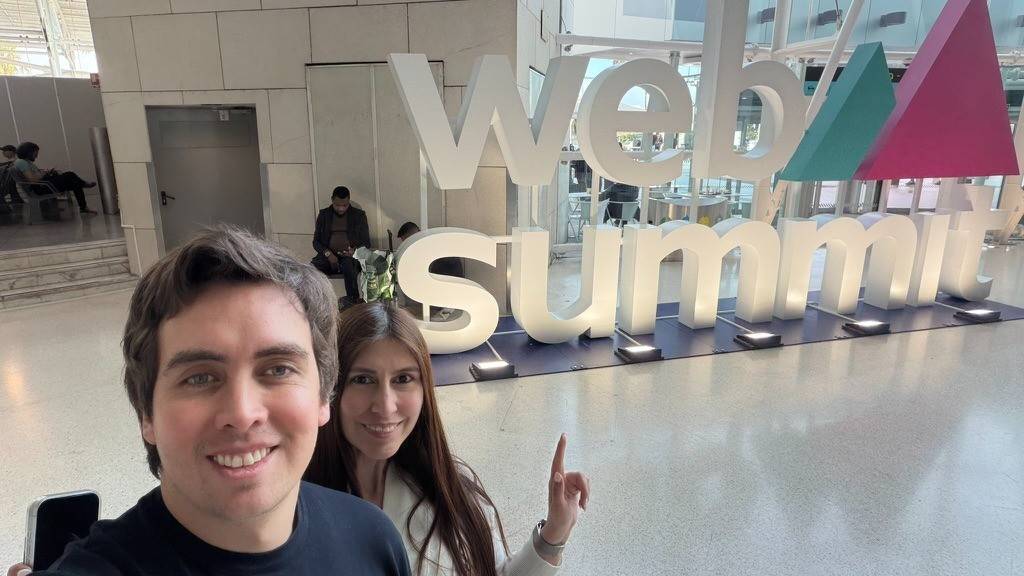
Last week I attended Web Summit in Lisbon for the first time, after years of following it through socials, listening to its speakers, and watching the event grow. This year was its tenth anniversary, so the timing felt right.
The funny thing is I bought the tickets at the start of the year — long before I knew I'd end up moving to Singapore. Buying that early gets you the famous 2x1. So my wife and I decided to go and combine a trip of inspiration, business, and exploring Lisbon again, which for me is an absolutely charming city.
If you've never been to Lisbon, Web Summit can be a great excuse. The weather's cool but not cold, you can mix work with leisure, and it's worth adding a couple of extra days.
The scale of the event (I underestimated it completely)
I'll be honest: I didn't imagine the event was THAT big.
Web Summit brings together close to 70,000 people from all over the world and from completely different industries. I thought it was more of a "marketing" event, but it's actually a huge entrepreneurial ecosystem where founders, governments, investors, and startups from many sectors all live together.
One of the most interesting things is that many countries sponsor the event with innovation programs: Portugal Startups / Lisbon Unicorns, Spain, Germany, Brazil, Malta, and more. Each country exhibits startups at Alpha (under 1M USD raised), Beta, and Growth stages. And there's EVERYTHING: fintech, marketing, legal, education, climate, health, AI, gaming…
If you like talking to founders — like I do — understanding what they're building, their business model, and their vision, it's incredible. And if you're thinking about investing, it's a great place to scout.
On content: the number of talks, forums, keynotes, interviews, and podcasts is enormous. There's a stadium-sized main stage and five more halls with simultaneous conferences. You need to be VERY organized to make the most of it: plan schedules, walk fast, arrive early to get into each stage.
Day one and first impressions
We arrived Monday morning and from the airport you already feel the Web Summit vibe. One thing I loved: you can pick up your badge at the airport, which makes everything easier.
At 5pm the main stage doors open with the first conferences. This year we attended an interview with a well-known content creator. Entertaining, sure, but I realized I personally prefer clear keynotes over panels with complex questions and very surface-level answers.
From there, we focused our entire agenda on keynotes.
The app helps a lot: not everything happens at the MEO convention center; there are activities all over the city. And here's something I'd never seen at other events: meetups by country (LatAm, Italy, France, etc.) and meetups by interest (wine, hiking, foodies, AI builders…). Perfect for connecting, learning… and yes, also for going out at night.
The content: the brilliant, the strange, and the brutally honest
As at any large event, you get all kinds: the super-prepared speaker, the one with unreadable slides, the one whose company forced them to attend, the one who answers a question nobody asked, and the one who leaves you with a sentence that shifts your perspective.
But realistically: we're in the era when EVERYONE talks about AI, and at Web Summit it was four straight days of "AI, AI, AI…". And still, out of hundreds of talks, I only saw one real, applied, operational case.
Everything else felt very "visionary," beautiful in slides, but still far from execution. That was my honest read.
I have a simple methodology: I don't try to remember entire presentations, I capture sharp lines that take me back to the context.
Here are the ones that stuck with me most:
The lines that stuck with me
"Innovation is our tradition." — Innovation is not a department or a project, it's a habit. A daily mindset. Something you practice consistently, not something you visit occasionally.
"Embracing an embarrassing culture is key for innovation." — Real innovation requires uncomfortable moments: ideas that feel silly at first, ugly prototypes, failed experiments. If a team only aims for "polished," it will never innovate.
"Companies die because they prioritize money over purpose." — When a company forgets its "why," it starts making short-term decisions. Loss of purpose, not competition, is what really kills great organizations.
"People do not trust AI yet at enterprise level." — Big organizations still face fear, bureaucracy, and real skepticism around AI accuracy, risk, and governance. That lack of trust slows adoption far more than the technology itself.
"Team is always the key." — No matter how advanced the technology, the quality of the team determines the quality of the result.
"AI leverages the nostalgia trend." — AI is accelerating the return of retro aesthetics, memories, and styles. Nostalgia is becoming a powerful emotional lever in creativity.
"B2B forgets their clients are humans." — Many B2B brands talk like machines. But behind every contract there's a human with emotions, fears, and motivations.
"CEO Social Networks are key for B2B engagement." — People trust people more than brands. A visible, authentic, active CEO on social platforms drives more engagement than any paid campaign.
"AI is the new infinity story engine." — AI can generate unlimited stories, variations, worlds, and creative outputs. It turns creativity into something exponential, not linear.
"Have you thought about the impossible ad? Make it with AI." — Technical and production barriers are disappearing. Ideas that once seemed impossible due to cost or logistics can now be made through AI.
"Create content for humans, not to trick the bots." — Brands need to stop optimizing content only for algorithms. Real impact comes from content that resonates with people, not machines.
"Promoting Engineer-Experts will be the role of the next years." — A new hybrid talent profile is emerging: technical experts who can also communicate, teach, and create.
"Humans excel at what AI still can't do: feel. AI + Human Touch unlocks a new level of creativity." — Emotion is still uniquely human. Combining human intuition with AI's scale and speed unlocks creative power neither could reach alone.
"Fear moves faster than algorithms." — Fear of change, of losing relevance, of failure — spreads through companies faster than any new technology.
"Creativity, collaboration, authenticity and relationships are the new way of working." — The future belongs to organizations that value creative teams, open collaboration, real human relationships, and authentic narratives, not rigid hierarchies.
"People need to feel again." — We're overwhelmed by information. Consumers crave emotion, connection, and experiences that move them, not just logic or data.
"AI needs cultural credibility to improve its usage." — For AI to be truly useful, it needs to understand culture, context, humor, accents, values, and local references.
"Brands need to build systems to use AI accordingly." — Experimentation is no longer enough. Companies need governance, workflows, processes, and internal systems to use AI responsibly and at scale.
Would I go back? Yes. 100%.
For three simple reasons:
- Portugal is a wonderful experience: incredible food, accessible prices for Europe, and a city full of charm. (Bring an umbrella because it rains, and shoes that don't slip.)
- It's the most diverse entrepreneurial event I've seen.
- There's a lot of value if you go with intention, organization, and curiosity.
Practical recommendations
- Buy tickets early. As a couple, around 900 euros if you grab the early bird.
- Book a hotel ahead of time. I recommend staying near Time Out Market: good area, excellent food, and great location.
- Moving by Uber is easy, but from the event the subway is faster to get back.
- Plan your agenda before. Talks fill up and the halls are far apart.
- Contact the people you want to meet BEFORE the event. It makes all the difference.
If you're thinking about going someday, my recommendation is simple: go.
Worst case, you spend a few days in one of the most beautiful cities in Europe. Best case, you come back with ideas, connections, inspiration, and a clearer vision of where the world is moving.
Comments(0)
Be the first to comment.
Keep reading